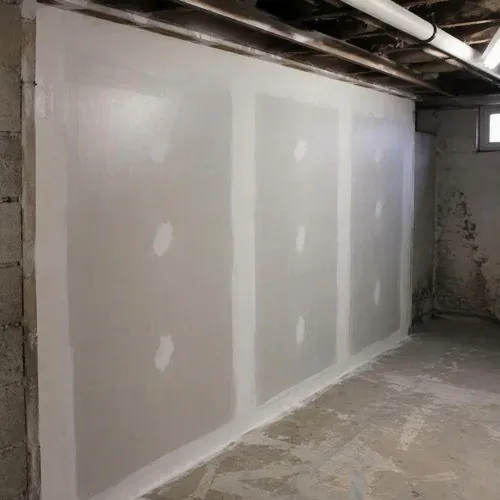
Water Damage Drywall Repair
Stained ceilings, sagging board and flooded basements. Wet material out, cavity dried, new board in and finished.
Water Damage Drywall Repair ›
St Catharines Elite Drywall repairs damaged drywall and ceilings for homeowners, landlords, property managers and realtors throughout the Niagara Region. We cover St. Catharines, Thorold, Niagara Falls, Welland and the surrounding towns, and most repairs can be quoted from a photo.
Doorknob holes and impact damage, settlement and hairline cracks, nail pops, damaged corner bead, openings left by TV mounts and removed fixtures, water-stained ceilings and sagging sections. Almost all of this work happens in occupied homes, so containment and dust extraction are part of the job rather than an extra.
Drywall is the only trade we do. More than twenty years, over 1,500 completed jobs, $2M liability insurance and full WSIB coverage.
Drywall repair is the removal and replacement of damaged gypsum board, or the rebuilding of a failed joint, so the finished surface is continuous with the wall around it. It covers anything from a single doorknob hole to a full ceiling section.
This service is for homeowners with visible damage, landlords turning units between tenancies, realtors preparing a listing, and property managers with recurring repairs across a portfolio.
Every repair includes backing where the opening needs it, a cut and fastened plug, taped perimeter, compound feathered wide, sanding with dust extraction, and texture matching where the surface is not smooth. Priming is included where it helps the paint take evenly. Painting the finished wall is not, and we will tell you when corner-to-corner repainting is the right call.
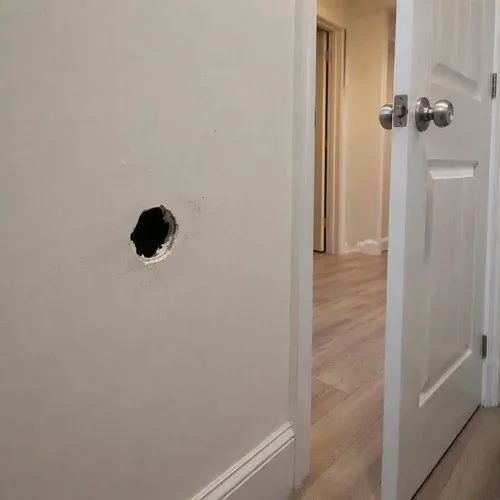
An invisible patch is a technique, not a promise. The sequence below is what separates a repair that disappears from one you can find in raking light two years later.
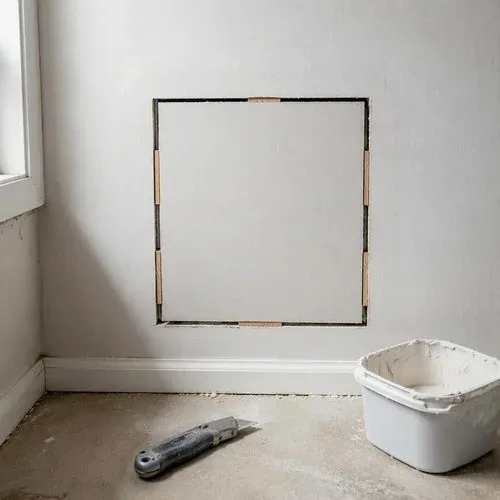
The damaged area is cut square. Ragged edges and crushed gypsum will not hold compound, so the opening always ends up slightly larger than the damage.
For anything wider than about 100mm, a plywood or board strip goes in behind the opening and is fastened to the surrounding board. Without backing the plug has nothing to hold it and will eventually move.
A piece of matching-thickness board is cut to the opening and fastened to the backing. Thickness has to match, or the patch sits proud or sunk.
The joint around the plug is taped, not simply filled. Filled joints crack along the seam. This is the single most common shortcut in amateur repair work.
Two to three coats, each wider than the last, feathered two to three times the width of the original damage.
Sanding with extraction attached, then texture applied and dialled in on a test board before it goes near your ceiling.
The material choice at each stage decides whether a repair holds or telegraphs through the paint later.
Setting compound, often called hot mud, cures by chemical reaction rather than drying. It comes in 20, 45 and 90 minute working times. It shrinks far less than premixed, which is why deep fills start with it.
Lightweight premixed compound such as Synko or CGC Sheetrock sands easily and feathers smoothly. It is the wrong choice for a deep first fill because it shrinks and cracks.
Paper tape embedded in compound produces a stronger joint than self-adhesive fibreglass mesh. Mesh has its place with setting compound on butt joints and small patches, but paper is the default.
Metal bead is strongest and belongs on high-traffic corners and stairwells. Vinyl will not dent or rust, which suits bathrooms and below-grade walls. Paper-faced bead gives the cleanest finish where impact is unlikely.
A handle through the wall behind a door, furniture damage during a move, or a foot through the drywall in a basement stairwell. Clean, fast, common.
Usually above door frames and window corners, where the wall is weakest and movement concentrates.
Small round bumps or chips appearing in a line across a wall or ceiling. The fastener has moved as the framing behind it dried and shrank.
Dented or split outside corners, most often in hallways and at the top of stairs where furniture and vacuum cleaners meet them.
TV mounts, shelving brackets, old thermostats, wall-mounted heaters, ceiling speakers. Anything that came down leaves something behind.
A brown ring, a soft patch, or a section starting to bow. Worth reading the water damage page as well, because the repair is only half the problem.
Everyone has seen a patch. A slightly different sheen, a faint rectangle in certain light, a shadow line around the edge. Five things cause it.
Compound built up over a small area creates a visible hump. A proper repair feathers out far wider than the damage itself.
Setting and premixed compound do different jobs. Using one where the other belongs produces shrinkage cracks or a patch that takes days too long.
Over-sanding scuffs the paper facing on the surrounding board, which then absorbs paint differently and rings the repair.
On a stipple or knockdown ceiling, a smooth patch in a textured field is more obvious than the original damage.
Even a perfect repair shows if fresh paint is spotted onto an aged wall, because new paint reflects light differently.
Where sheen is the risk we will tell you to paint the full wall corner to corner rather than pretend a spot touch-up will disappear.
Sanding joint compound produces a fine dust that travels. Left unmanaged it ends up in carpet, on top of kitchen cabinets and inside the furnace return.
We contain the work area with poly and tape, cover floors and furniture, and run dust extraction at the sanding stage rather than sweeping up afterwards. When we leave, the room should be usable.
If you have a newborn, someone with respiratory issues, or an open-plan layout that makes containment harder, tell us when you call. It changes how we set up.
There is a difference between damage and a symptom. A doorknob hole is damage, and filling it properly ends it. A crack you have already filled twice is a symptom, and filling it a third time buys about a year.
Recurring cracks usually trace to one of these:
When we look at a recurring crack we are looking for the cause first. Sometimes the joint has to be cut out and rebuilt. Sometimes the movement has to be accommodated rather than resisted.
What moves it: how many separate areas, whether texture has to be matched, ceiling height, whether the damage is structural or cosmetic, and how much containment the space needs.
Small jobs carry a minimum because travel and setup cost the same whether we patch one hole or six. If you have several small repairs pending, have them done in one visit. The per-hole cost drops sharply.
Full detail on our Niagara drywall cost guide.
| Job | Typical range |
|---|---|
| Minimum service call | $250 to $400 |
| Small patch, single hole | $250 to $500 |
| Several patches in one visit | $400 to $900 |
| Room-scale repair | $600 to $1,500 |
| Ceiling section with texture matching | $700 to $2,000 |
We are based on Vine Street in St. Catharines. For most of the region we can be on site for a quote within a day or two, and booked in within the following week.
Urgent water damage moves to the front of the queue, because delay makes that job bigger. A doorknob hole does not, and we will say so rather than promising same-day and then rescheduling.
Send a photo and we can often skip the site visit entirely and go straight to a number.
Walls after a move-out, patched and prepped between tenancies. Speed matters most when a unit has to be listed.
Buyers notice wall damage disproportionately. Patching before photos pays for itself.
Multiple units on one schedule, priced accordingly.
If you manage properties across St. Catharines, Thorold, Welland or Niagara Falls, talk to us about recurring work.
We warrant our repair workmanship and state the term in writing on the quote. If a patch we installed cracks at the perimeter or a plug moves, we come back and fix it.
What a workmanship warranty cannot cover is continued building movement. If a crack reopens because the structure is still moving, that is a diagnosis problem rather than a repair defect, and we will tell you that before taking the job rather than after.
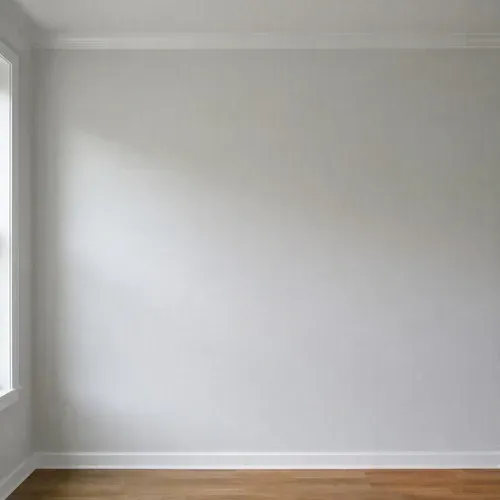
The fastest way to get a number is to send a photo of the damage with a rough idea of the size. Most repairs can be quoted from a picture without anyone needing to visit.
A few stages from recent work. Every job ends with a raking-light inspection before we call it finished.
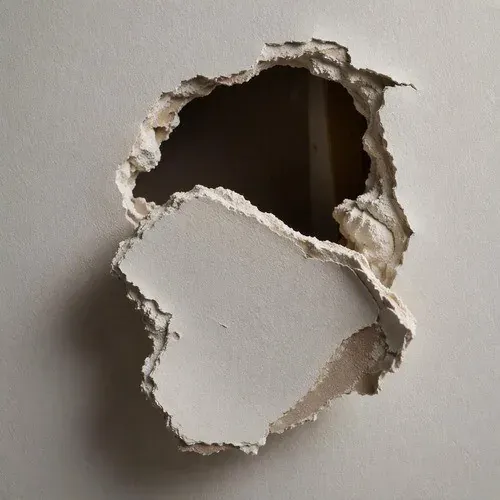
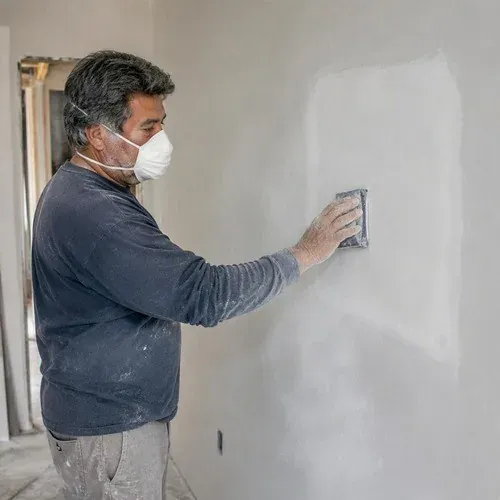
On a smooth wall, a properly executed patch should be invisible. On a textured ceiling a good match lands around 85 to 95 percent, usually undetectable in normal light. Anyone promising a perfect texture match has not done enough of them.
We prime repairs where it helps, but we are drywall specialists, not painters. For a wall with existing colour, painting corner to corner gives a far better result than spot-painting.
Any size, subject to the minimum call-out. If you have one small hole, consider whether anything else has been waiting, since the visit costs the same.
Usually yes. See textured ceiling and wall repairs for how close a match realistically gets.
Typically 24 hours after the final coat, though it depends on the compound, the thickness and the humidity in the room.
No. A stain means water came through, and the board may have lost integrity even if it looks dry now. Painting over it traps the problem.
Yes, and it is stated up front before we book. Travel and setup cost the same regardless of hole size.
Yes. Plaster is a different material with different failure modes, and we treat it that way. See plaster repair.
Stained ceilings, sagging board and flooded basements. Wet material out, cavity dried, new board in and finished.
Water Damage Drywall Repair ›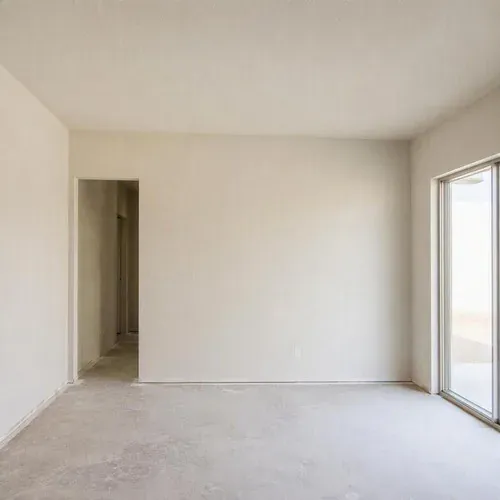
Knockdown, orange peel, swirl and stipple matched across a patch so the repaired area reads as original.
Textured Ceiling & Wall Repairs ›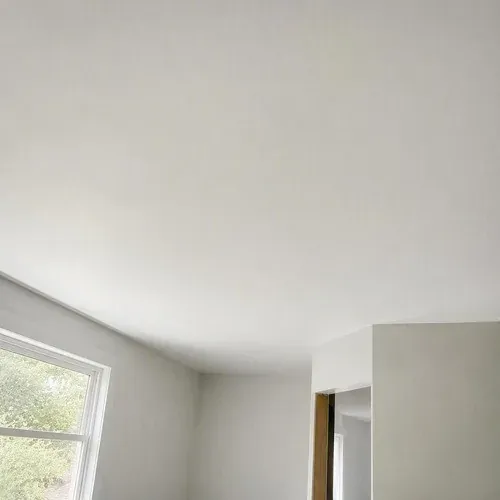
Recessed light holes plugged, mudded and textured out, including the ones left behind when a fixture layout changes.
Pot Light Hole Repair ›
Lath and plaster in century homes fails differently than drywall. We repair it as plaster, not by patching it like board.
Plaster Repair ›We cover every town in Niagara from our shop on Vine Street in St. Catharines. These are the areas where this service comes up most.
Tell us what you are dealing with and roughly where in Niagara you are. For repairs, a photo is usually enough for a number without a site visit.